%20--%3e%3cdefs%3e%3cstyle%3e%20.st0%20{%20fill:%20%23fff;%20}%20.st1%20{%20fill:%20none;%20stroke:%20%23fff;%20stroke-miterlimit:%2010;%20stroke-width:%206px;%20}%20%3c/style%3e%3c/defs%3e%3cg%3e%3cpath%20class='st0'%20d='M417.24,118.79c-3.8-2.16-8.23-3.24-13.28-3.24s-9.34,1.08-13.14,3.24c-3.8,2.16-6.79,5.17-8.95,9.01-2.16,3.85-3.24,8.29-3.24,13.33s1.08,9.49,3.24,13.33c2.16,3.85,5.14,6.85,8.95,9.01,3.8,2.16,8.18,3.24,13.14,3.24s9.48-1.08,13.28-3.24c3.8-2.16,6.77-5.16,8.89-9.01,2.12-3.84,3.18-8.29,3.18-13.33s-1.06-9.48-3.18-13.33c-2.12-3.84-5.08-6.85-8.89-9.01Z'/%3e%3cpolygon%20class='st0'%20points='151.81%20153.61%20175.45%20153.61%20163.58%20122.87%20151.81%20153.61'/%3e%3cpath%20class='st0'%20d='M52.88,83.15v116.54h737.24v-116.54H52.88ZM119.01,154.22h-30.49v28.93h-19.1v-84.05h52.72v17.29h-33.62v21.01h30.49v16.82ZM185.9,183.15l-5.64-14.53h-33.37l-5.64,14.53h-20.42l33.39-84.05h18.72l33.39,84.05h-20.42ZM283.64,168.81c-4.08,5.08-9.13,9.03-15.18,11.83-6.05,2.79-12.75,4.19-20.11,4.19-8.49,0-16.02-1.86-22.59-5.58-6.56-3.73-11.68-8.87-15.37-15.43-3.68-6.57-5.52-14.13-5.52-22.7s1.84-16.13,5.52-22.7c3.69-6.57,8.79-11.71,15.31-15.43,6.52-3.72,14.03-5.58,22.53-5.58,7.13,0,13.66,1.36,19.58,4.08,5.92,2.72,10.9,6.57,14.95,11.54,4.04,4.96,6.86,10.8,8.46,17.52h-19.7c-1.6-4.65-4.44-8.31-8.53-10.99-4.08-2.68-8.79-4.02-14.15-4.02-4.73,0-8.96,1.08-12.67,3.24-3.72,2.16-6.63,5.17-8.71,9.01-2.08,3.85-3.12,8.29-3.12,13.33s1.04,9.49,3.12,13.33c2.09,3.85,4.97,6.85,8.65,9.01,3.68,2.16,7.88,3.24,12.61,3.24,5.52,0,10.35-1.42,14.51-4.26,4.17-2.84,7.13-6.67,8.9-11.47h19.69c-1.36,6.8-4.08,12.74-8.17,17.83ZM355.57,183.15h-56.55v-84.05h55.23v16.09h-36.26v17.41h33.02v15.98h-33.02v18.36h37.58v16.21ZM443.1,163.82c-3.83,6.56-9.12,11.7-15.84,15.43-6.73,3.72-14.49,5.58-23.3,5.58s-16.46-1.86-23.23-5.58c-6.77-3.73-12.05-8.87-15.85-15.43-3.8-6.57-5.71-14.13-5.71-22.7s1.9-16.13,5.71-22.7c3.8-6.57,9.09-11.71,15.85-15.43,6.77-3.72,14.51-5.58,23.23-5.58s16.58,1.86,23.3,5.58c6.72,3.72,12,8.87,15.84,15.43,3.84,6.57,5.77,14.13,5.77,22.7s-1.93,16.13-5.77,22.7ZM475.53,183.15h-19.1v-84.05h52.72v17.29h-33.62v21.01h30.49v16.82h-30.49v28.93ZM496.23,183.15l48.03-84.05,48.03,84.05h-96.06ZM618.08,183.15h-19.1v-84.05h19.1v84.05ZM696.49,116.99h-26.66v66.16h-19.1v-66.16h-26.66v-17.9h72.41v17.9ZM773.57,183.15h-19.1v-33.86h-32.89v33.86h-19.1v-84.05h19.1v32.3h32.89v-32.3h19.1v84.05Z'/%3e%3c/g%3e%3crect%20class='st1'%20x='37'%20y='67.06'%20width='768.97'%20height='148.5'/%3e%3c/svg%3e)
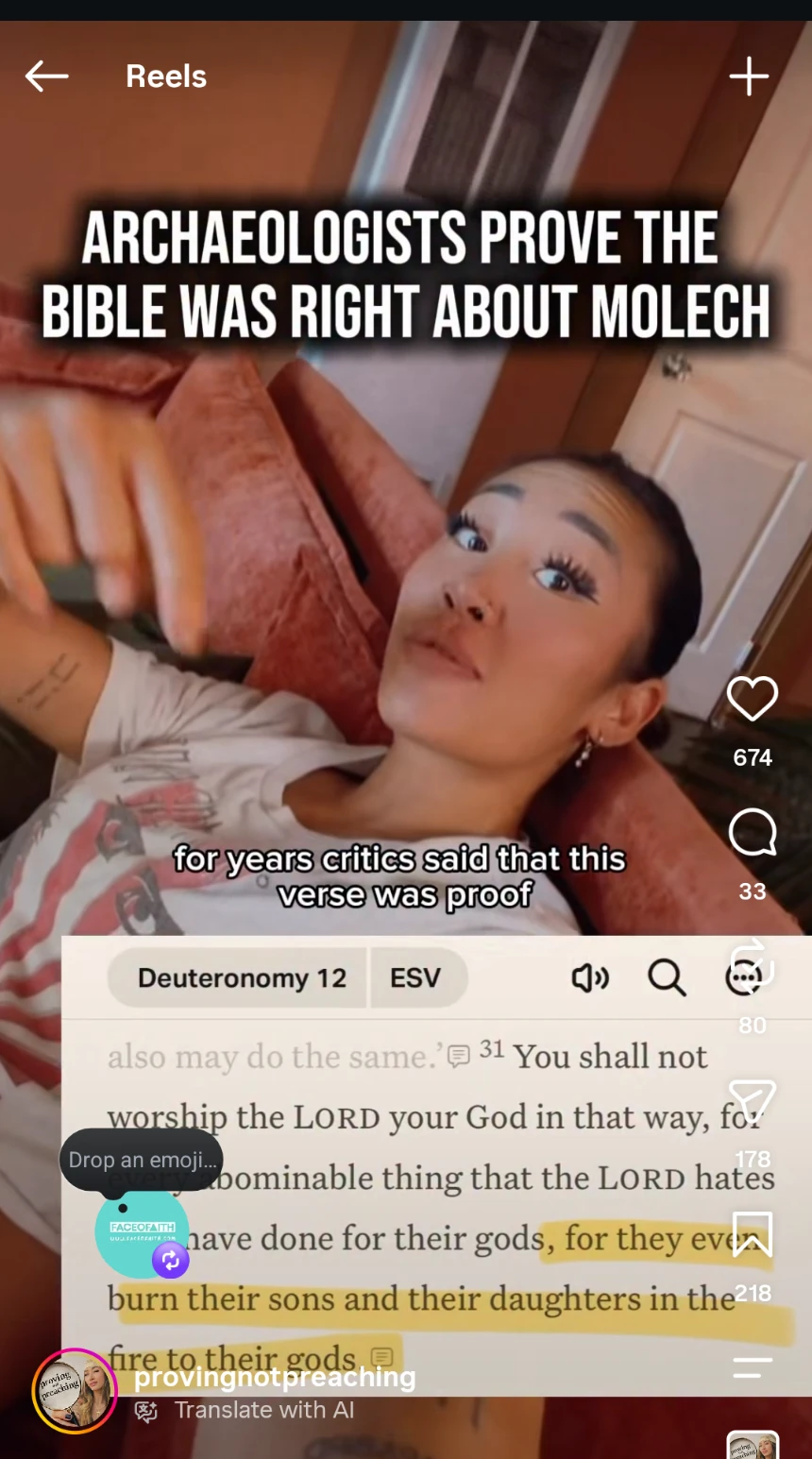
For years this verse was used by critics as proof the bible couldn't be trusted
Instagram · Under 5 minutes
Reflection
For years critics pointed at Deuteronomy 12:31 as proof the Bible couldn't be trusted. On the surface, it seems to say the Lord's people did burn their sons and daughters, which would make the God of the Bible monstrous. But read the verse in full and the accusation falls apart. You shall not worship the LORD your God in that way, for every abominable thing that the LORD hates they have done for their gods, for they even burn their sons and their daughters in the fire to their gods. The verse is not describing God's people. It is a command not to copy what the nations around them did, and it names the practice with horror. That is where archaeology has spoken. Excavations of burial grounds from the ancient world, most famously the tophet at Carthage and similar Phoenician and Canaanite sites, have uncovered urns containing the remains of young children, alongside inscriptions dedicating them to the gods in fulfilment of a vow. What the Bible reported as a real and terrible practice in the nations around Israel has been dug out of the ground. The critics assumed the Bible was being criticised; the evidence showed the Bible was describing the world accurately. This is a pattern worth noticing. The Scriptures do not hide the darkness of the ancient world, or of Israel's own failures; they record it honestly and set God's character against it. You shall not give any of your children to offer them to Molech, and so profane the name of your God (Leviticus 18:21). They did not sacrifice their sons and their daughters... so that the land was polluted with the blood of the innocent (Psalm 106:37-38). Far from endorsing the practice, the Bible condemns it in the strongest terms, and the archaeology confirms that the condemnation was aimed at something that genuinely happened. Read a passage in its context before you accept the summary someone gives you of it.
Questions to sit with
- Have you ever heard a verse quoted out of context and taken as proof the Bible is wrong? How would you check it for yourself?
- Archaeology keeps confirming details of the biblical world, from the nations around Israel to the ancient practice of child sacrifice. How does that shape your confidence in Scripture?
- Deuteronomy 12:31 is a command not to copy the surrounding culture. What practices in our own culture does it challenge you to refuse?