%20--%3e%3cdefs%3e%3cstyle%3e%20.st0%20{%20fill:%20%23fff;%20}%20.st1%20{%20fill:%20none;%20stroke:%20%23fff;%20stroke-miterlimit:%2010;%20stroke-width:%206px;%20}%20%3c/style%3e%3c/defs%3e%3cg%3e%3cpath%20class='st0'%20d='M417.24,118.79c-3.8-2.16-8.23-3.24-13.28-3.24s-9.34,1.08-13.14,3.24c-3.8,2.16-6.79,5.17-8.95,9.01-2.16,3.85-3.24,8.29-3.24,13.33s1.08,9.49,3.24,13.33c2.16,3.85,5.14,6.85,8.95,9.01,3.8,2.16,8.18,3.24,13.14,3.24s9.48-1.08,13.28-3.24c3.8-2.16,6.77-5.16,8.89-9.01,2.12-3.84,3.18-8.29,3.18-13.33s-1.06-9.48-3.18-13.33c-2.12-3.84-5.08-6.85-8.89-9.01Z'/%3e%3cpolygon%20class='st0'%20points='151.81%20153.61%20175.45%20153.61%20163.58%20122.87%20151.81%20153.61'/%3e%3cpath%20class='st0'%20d='M52.88,83.15v116.54h737.24v-116.54H52.88ZM119.01,154.22h-30.49v28.93h-19.1v-84.05h52.72v17.29h-33.62v21.01h30.49v16.82ZM185.9,183.15l-5.64-14.53h-33.37l-5.64,14.53h-20.42l33.39-84.05h18.72l33.39,84.05h-20.42ZM283.64,168.81c-4.08,5.08-9.13,9.03-15.18,11.83-6.05,2.79-12.75,4.19-20.11,4.19-8.49,0-16.02-1.86-22.59-5.58-6.56-3.73-11.68-8.87-15.37-15.43-3.68-6.57-5.52-14.13-5.52-22.7s1.84-16.13,5.52-22.7c3.69-6.57,8.79-11.71,15.31-15.43,6.52-3.72,14.03-5.58,22.53-5.58,7.13,0,13.66,1.36,19.58,4.08,5.92,2.72,10.9,6.57,14.95,11.54,4.04,4.96,6.86,10.8,8.46,17.52h-19.7c-1.6-4.65-4.44-8.31-8.53-10.99-4.08-2.68-8.79-4.02-14.15-4.02-4.73,0-8.96,1.08-12.67,3.24-3.72,2.16-6.63,5.17-8.71,9.01-2.08,3.85-3.12,8.29-3.12,13.33s1.04,9.49,3.12,13.33c2.09,3.85,4.97,6.85,8.65,9.01,3.68,2.16,7.88,3.24,12.61,3.24,5.52,0,10.35-1.42,14.51-4.26,4.17-2.84,7.13-6.67,8.9-11.47h19.69c-1.36,6.8-4.08,12.74-8.17,17.83ZM355.57,183.15h-56.55v-84.05h55.23v16.09h-36.26v17.41h33.02v15.98h-33.02v18.36h37.58v16.21ZM443.1,163.82c-3.83,6.56-9.12,11.7-15.84,15.43-6.73,3.72-14.49,5.58-23.3,5.58s-16.46-1.86-23.23-5.58c-6.77-3.73-12.05-8.87-15.85-15.43-3.8-6.57-5.71-14.13-5.71-22.7s1.9-16.13,5.71-22.7c3.8-6.57,9.09-11.71,15.85-15.43,6.77-3.72,14.51-5.58,23.23-5.58s16.58,1.86,23.3,5.58c6.72,3.72,12,8.87,15.84,15.43,3.84,6.57,5.77,14.13,5.77,22.7s-1.93,16.13-5.77,22.7ZM475.53,183.15h-19.1v-84.05h52.72v17.29h-33.62v21.01h30.49v16.82h-30.49v28.93ZM496.23,183.15l48.03-84.05,48.03,84.05h-96.06ZM618.08,183.15h-19.1v-84.05h19.1v84.05ZM696.49,116.99h-26.66v66.16h-19.1v-66.16h-26.66v-17.9h72.41v17.9ZM773.57,183.15h-19.1v-33.86h-32.89v33.86h-19.1v-84.05h19.1v32.3h32.89v-32.3h19.1v84.05Z'/%3e%3c/g%3e%3crect%20class='st1'%20x='37'%20y='67.06'%20width='768.97'%20height='148.5'/%3e%3c/svg%3e)
Can We Hear God? Maybe God Isn’t Hiding. Maybe We’ve Simply Never Learned How to Notice Him
Can We Hear God? Are We Listening for Him?
Can we actually hear God?
It is a question that Christians have wrestled with for centuries, but perhaps there is another question we should ask first.
Have we really looked for Him?
Not casually. Not occasionally. Not just when life falls apart and we need an answer.
Have we genuinely looked?
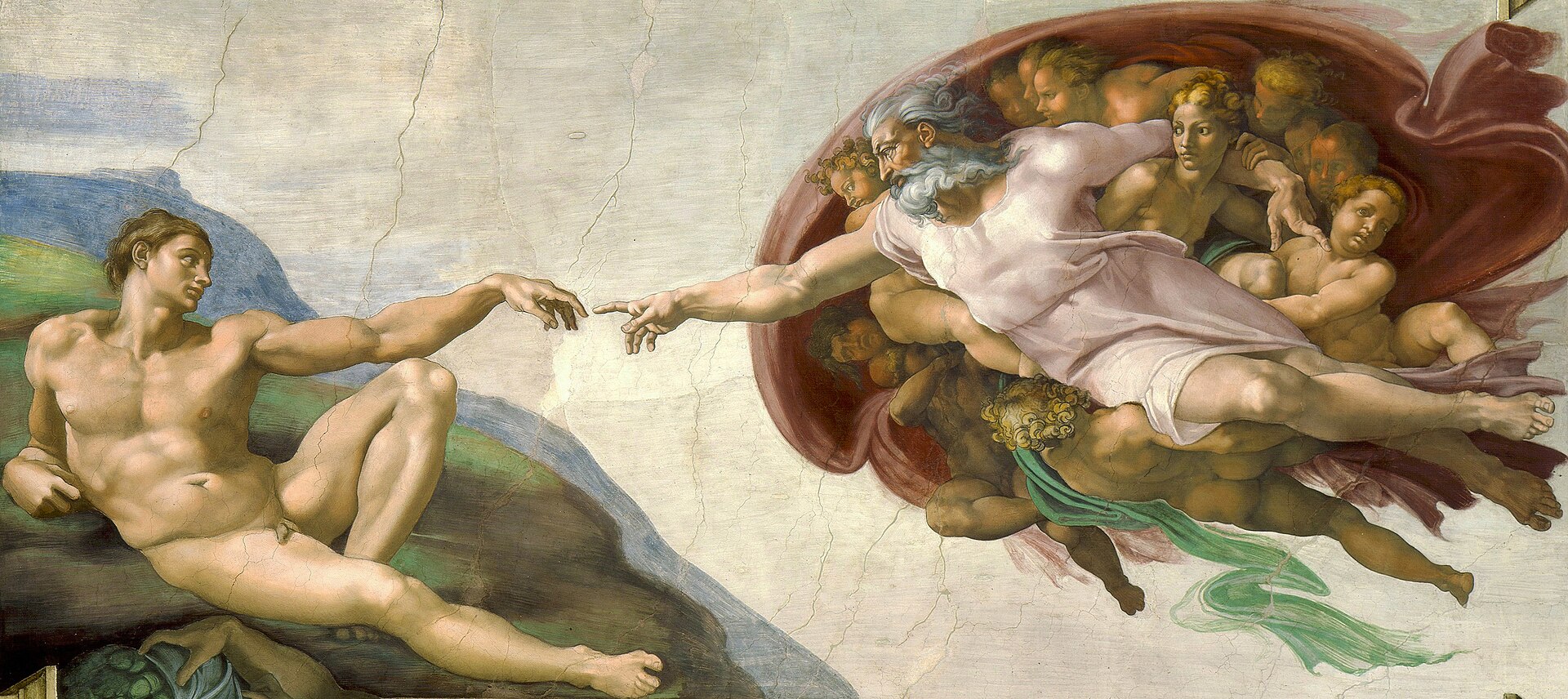
There is something about Michelangelo’s famous Creation of Adam that has always struck me. God is reaching towards Adam, His finger extended, almost waiting for that connection. And yet Adam barely reaches back. His hand is there, but there is a sense of hesitation, almost indifference, as though the connection is being offered but not fully pursued.
Perhaps that image says something about us.
We often ask, “Where is God?”
But what if the question sometimes needs to be, “Where am I looking?”
What if God is closer than we realise?
The Bible repeatedly describes God as a God who speaks, calls, reveals, guides and draws people towards Him.
Jesus said, “My sheep hear my voice, and I know them, and they follow me.” The Bible also tells us to seek God, to draw near to Him, to ask, to knock and to keep searching.
That doesn't necessarily mean we should expect to hear an audible voice telling us what to do. God can speak through Scripture, through prayer, through conviction, through other people, through circumstances and through the quiet prompting of conscience. Sometimes what we interpret as coincidence may simply be coincidence. Sometimes it may be something more. The challenge is learning to discern the difference.
And perhaps that is where the question of sin becomes uncomfortable.
Does sin make it harder to see God?
The Christian understanding of sin isn't simply that God is waiting to punish us for breaking rules. Sin can also distort our relationship with Him. It can turn our attention away from God and towards ourselves.
Imagine trying to see through a dirty window. The landscape hasn't disappeared. The light hasn't stopped shining. But the glass is affecting what you can see.
Perhaps sin can sometimes work like that.
When we deliberately live in ways we know are contrary to what we believe God is asking of us, our spiritual vision can become clouded. We become less receptive to conviction. We learn to ignore the uncomfortable voice inside us. We justify things we once knew were wrong. Eventually, we can become so accustomed to filtering God out that His presence feels absent.
But there is an important distinction here.
God's presence doesn't disappear because we sin.
If that were the case, none of us would have any hope of finding Him.
Christianity teaches almost the opposite. God moves towards people in their brokenness. Jesus didn't come because humanity had cleaned itself up. He came because we hadn't.
The issue isn't that God has moved away.
Perhaps sometimes we have.
And the wonderful thing about Christianity is that the journey back isn't about becoming perfect before approaching God. It is about turning towards Him.
Prayer isn't just talking. It's listening.
We can make prayer into a shopping list.
“God, please give me this.”
“God, fix that.”
“God, help me with this problem.”
And there is nothing wrong with bringing our needs to God. Jesus Himself taught His followers to pray for their daily needs.
But prayer can become something much deeper.
What if we stopped talking for a moment and listened?
Not necessarily for a booming voice from heaven. But for conviction. For wisdom. For a change in perspective. For something in Scripture that suddenly speaks directly into a situation. For the uncomfortable realisation that perhaps the answer isn't what we wanted to hear.
Sometimes God's answer may not be spectacular.
Sometimes it might simply be a growing sense that we need to change direction.
Sometimes it might be peace where there should be panic.
Sometimes it might be the right person appearing at exactly the right moment.
And sometimes it might be nothing more than a quiet thought that causes us to stop and ask, “Was that just me?”
That is where discernment becomes important. Not every thought is God. Not every coincidence is a miracle. Not every feeling is the Holy Spirit.
But neither should we assume that everything meaningful is meaningless simply because we cannot scientifically measure its source.
What are we filtering out?
There is an interesting parallel between this and the way our brains process information.
We are surrounded by an enormous amount of sensory information every second. Light, sound, movement, temperature, smells, touch and countless other signals are reaching our senses. Yet our conscious attention can only deal with a tiny fraction of what is available.
The often-repeated claim that the brain processes only around 10 bits per second is a simplified scientific estimate and shouldn't be treated as a precise fact. But the underlying principle is real: our brains filter an extraordinary amount of information before it reaches conscious awareness.
Think about buying a particular car.
You could drive past the same model every day and barely notice it. Then you decide you're going to buy one.
Suddenly, they're everywhere.
Did thousands of identical cars suddenly appear on the roads?
Of course not.
Your attention changed.
The cars were already there. Your brain simply started identifying them as relevant.
This happens constantly.
Once you learn a new word, you start noticing it everywhere. Once you become interested in something, you suddenly see it in places you never noticed before.
So here's the uncomfortable spiritual question:
Could we be filtering God out of our lives in a similar way?
Not because God isn't there, but because we aren't looking for Him.
What if we actually started looking?
There is a difference between believing that God might exist and genuinely searching for Him.
You can spend years saying, “If God wants me to know He's there, He'll have to prove it.”
But is that really searching?
Imagine someone standing outside your house saying, “If you want me to know you're there, you'll have to come outside.”
And you are sitting inside with the curtains closed.
At some point, perhaps the problem isn't that nobody is there.
Perhaps you simply haven't opened the curtains.
Jesus repeatedly used the language of seeking.
“Seek and you will find.”
Knock.
Ask.
Search.
There is an invitation in those words.
Not a demand that you manufacture belief, but an invitation to genuinely investigate.
Open the Bible.
Pray honestly.
Ask God to reveal Himself if He is real.
Go to church.
Speak to Christians who have experienced something you haven't.
Question your assumptions.
Look at the historical claims surrounding Jesus.
And perhaps most importantly, don't only ask God to give you the answer you want.
Ask Him to show you the truth.
Even if the truth challenges you.
Since coming to Christ, I've started noticing something different
This is where I have to move from the theoretical to the personal.
Since coming to Christ, I have experienced what I can only describe as coincidence after coincidence.
Moments that, individually, could easily be explained away.
A conversation.
A person appearing at just the right time.
Something I needed to hear appearing in front of me.
A passage of Scripture suddenly making sense in a situation I was facing.
A chain of events that, when viewed separately, could be dismissed as chance, but when placed together began to feel like something else.
I can't scientifically prove that every one of those moments was God.
And I don't think we should pretend that we can.
But something changed in me.
I started looking.
And when I started looking, I started noticing.
It's almost like walking down a familiar lane that you've travelled hundreds of times and suddenly realising how much beauty was always there.
The trees.
The light.
The clouds.
The birds.
The tiny details you previously walked straight past.
The lane hasn't changed.
You have.
And perhaps that is part of what happens when we begin to seek God.
The world doesn't necessarily become different overnight.
But we begin to see it differently.
The beauty becomes more than beauty.
A sunrise can become a reminder.
A moment of peace can become something worth noticing.
A conversation can become an opportunity.
A coincidence can become a question.
A conviction can become an invitation to change.
And suddenly, everywhere you look, you begin asking:
“Is God leaving fingerprints here?”
Maybe the question isn't whether God is speaking
Perhaps the bigger question is whether we have become quiet enough to listen.
We live in a world filled with noise. Notifications, entertainment, music, advertising, opinions, arguments, news, social media and endless distractions.
Our attention is constantly being fought over.
And then we wonder why we struggle to hear God.
Maybe we need to create some silence.
Maybe we need to put the phone down.
Maybe we need to stop talking long enough to listen.
Maybe we need to open Scripture without already deciding what we want it to say.
Maybe we need to pray a different prayer.
Not:
“God, give me what I want.”
But:
“God, if You are there, show me who You are. Show me what is true. Show me where I am wrong. Show me what You want me to see.”
That is a dangerous prayer.
Because if you genuinely mean it, you might have to change.
You might have to let go of things.
You might have to apologise.
You might have to forgive someone.
You might have to surrender something you have built your identity around.
You might have to admit that some of the things you thought were freedom were actually chains.
But perhaps that is what alignment with God really means.
Not getting God to fit into our lives.
But allowing our lives to come into alignment with Him.
Are we reaching back?
Michelangelo's Adam is still reaching out.
But God's hand is extended towards him.
There is something incredibly powerful about that image.
God reaching.
Adam barely responding.
Perhaps sometimes we are Adam.
God may be closer than we think, while our attention is somewhere else.
We ask why we can't see Him while looking everywhere except towards Him.
We ask why we can't hear Him while filling every quiet moment with noise.
We ask why we don't feel His presence while deliberately holding onto things that are pulling us away from Him.
And yet the invitation remains.
Seek.
Knock.
Ask.
Draw near.
Maybe you've never really looked.
Maybe you've looked, but only from a distance.
Maybe you've already decided what God must be like before giving Him the opportunity to show you.
Or maybe you've been looking for years and still have questions.
That's okay.
Faith isn't pretending you have no questions.
Sometimes faith begins with having the courage to ask the question honestly.
“God, are You there?”
And then, for once, instead of immediately moving on with our lives, perhaps we should stop.
Be quiet.
Look.
Listen.
And genuinely wait for an answer.
Because maybe God isn't hiding.
Maybe we've simply never learned how to notice Him.
I think the strongest part for Face of Faith is the central idea: “Maybe God isn't hiding. Maybe we've simply never learned how to notice Him.” It gives the article an invitation to sceptics as well as Christians, without claiming that every coincidence is automatically divine.